Work calendar
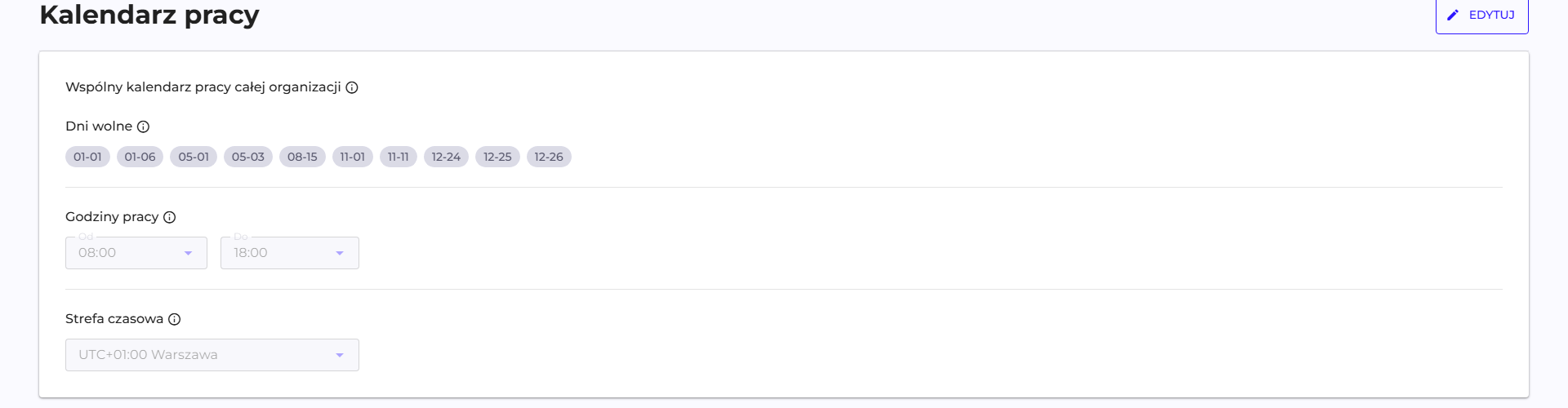
A single, shared calendar for the whole organization.
| Field | What it does | Format and default value |
|---|---|---|
| Days off | dates skipped when counting working days | MM-DD only, repeating every year |
| Working hours | the range of hours treated as working time | 8:00-18:00 by default |
| Time zone | the zone in which the hours are interpreted | 19 options to choose from, Europe/Warsaw by default |
Weekends are always excluded from working days, and this cannot be changed. There is therefore no need to add Saturdays or Sundays to the list of days off.
The MM-DD format means a fixed date repeated every year, so holidays with a variable date, such as Easter Monday or Corpus Christi, must be entered by hand for each year separately, remembering to update the list.
All three fields determine the time from which Lead Time and Cycle Time are calculated in Flow Metrics. Only working hours in the selected time zone enter the result, skipping weekends and days off. Days off also affect Throughput, which converts completed tickets to a working week. Flow velocity, Flow distribution and Work in progress, calculated as the state at the end of the period, do not depend on working hours or time zone. Working hours also serve metrics calculated on an hourly basis, including the detection of work outside hours.
Saving a change to any of these fields recalculates Lead Time and Cycle Time for the whole organization, also retroactively. The tooltip next to the "Working hours" field warns that this can take a few minutes. Until the recalculation finishes, the cards for both metrics in the project view show No data.
See also
- Work Dynamics Indexes: metrics calculated in working days
- Flow Metrics: Lead Time and Cycle Time calculated in working days
- Workload: cell capacity calculated from working days